
Communicating on climate change is about educating and mobilizing audiences to take action to confront the climate crisis. Everyone can play a part by raising their voice, sharing solutions, and advocating for change – shaped by different experiences, cultural contexts, and underlying values.
If you are creating a communications product – such as a video, a podcast, a written article,
or a graphic on climate change – keep in mind the following tips to make it a
valuable, effective, and reliable piece of content.
1. Use authoritative scientific information
WHY?
Misinformation and disinformation are widespread on the issue of climate change – and they are major obstacles towards progress in tackling the climate crisis. Deceptive or misleading content distorts the perception of climate science and solutions, creates confusion, and often leads to delays in action or even harmful action. “Rhetoric and misinformation on climate change and the deliberate undermining of science have contributed to misperceptions of the scientific consensus, uncertainty, disregarded risk and urgency, and dissent,” according to the Intergovernmental Panel on Climate Change (IPCC).
HOW?
- Check your sources. When sharing facts and figures, make sure they come
from a reliable source, which is science-based (consistent with the latest scientific
consensus) and objective (not biased or influenced by financial or political incentives).
Peer-reviewed
articles (reviewed by experts in the same field prior to publication) generally provide the
most reliable information. A uniquely authoritative source is the UN’s Intergovernmental Panel on Climate
Change, whose comprehensive assessments are written by hundreds of leading
scientists, with contributions from thousands of experts, and endorsed by its 195 member
countries.
- Stop misinformation. Things you post online can spread very fast. Pause before you share
something. Find out who made it, what sources it is based on, who paid for it, and who might
be profiting from it. If you detect misinformation among your followers, rebut it by using the
‘Fact,
Myth, Fallacy’ model that can help convey your message in a way that will stick.
Can you spot false claims on climate change? Take the quiz here.
- Beware of greenwashing (presenting a company or product as environmentally
friendly when they actually aren’t). Double-check what
the company is really doing to reduce their carbon footprint and deliver on their
climate promises, and only promote genuinely sustainable brands that meet certain minimum
criteria. When taking on
work that is financially rewarding, be careful to challenge the assignment to make sure it
promotes sustainable behaviours.
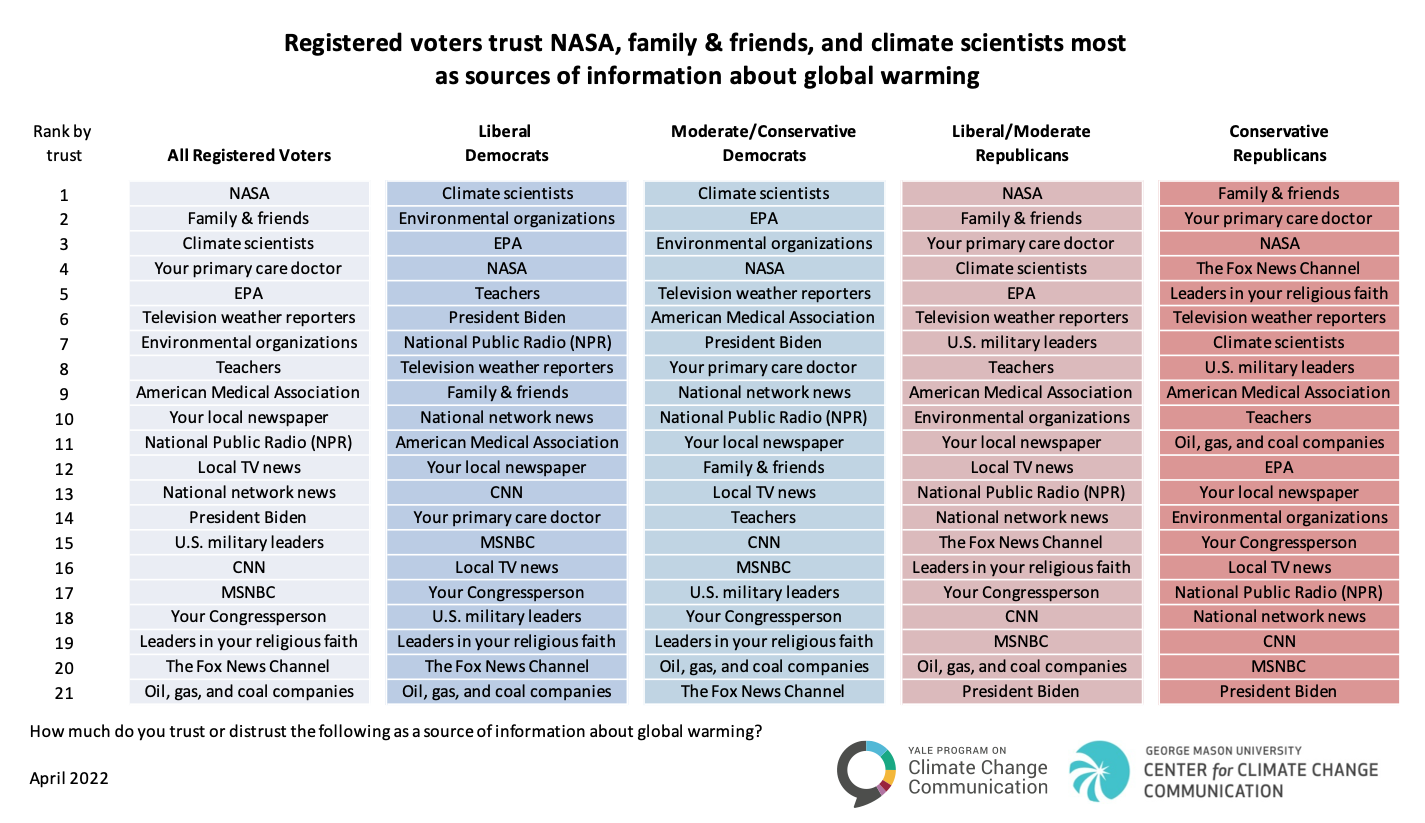
- Use trusted messengers. Breaking down the science behind climate change is
complex, but the right messengers can get the audience engaged. As an established content
creator, you may already be a trusted messenger for your audience. If you bring in other
messengers, consider respected scientists (whose articles refer to peer-reviewed scientific
journals or studies conducted by reputable research institutions or universities), weather
presenters, and medical doctors, all of which are widely trusted.
Often the most impactful climate communications also come from “people
like me” who are affected and care.
2. Convey the problem and the solutions
WHY?
Explaining the scale of the climate crisis is important, but it can seem overwhelming, leading people to lose interest and tune out. Climate change is one of the greatest challenges humankind has faced. It is daunting, but the fight against climate change is far from lost. The worst impacts can still be averted if we act now. A good way around disillusionment and “crisis fatigue” is to convey a hopeful message focused on the solutions, helping people feel empowered and motivated to engage.
HOW?
- Tell a story – make it real. Presenting data alone may numb the audience.
Make it relatable, local, and personal.
Individual stories can
forge an emotive connection, get the
audience to care, and make shared global challenges seem less daunting. You don’t even need to
lead with the word ‘climate’ but start with a related issue that is important to your
audience. Air pollution, for instance, which cities like Dar
es Salaam are tackling by introducing soot-free buses. Or new job opportunities
offered by clean energy projects, like in this story from India. Or power outages during
hurricanes, which Puerto
Rico is tackling by installing solar power. Learn more about how to start a
conversation about climate change here.
- Empower people. Let people know that they have the power to effect change.
Individual action and systemic change go hand
in hand. Individuals can
help drive change by shifting consumption patterns and demanding action by governments and
corporations. Small steps by a large number of
people can help persuade leaders to make the big changes we need. And the more people act now and speak
up for change, the bigger the pressure on leaders to act.
- Link it to justice. Climate change is not just about science, it is also an
issue of justice.
The poor and marginalized are often hit the hardest by
increasing climate hazards like floods, droughts, and storms. Those who contributed the least
to greenhouse gas emissions are too often affected the most. And financial commitments of
support by wealthier countries have not been met. Solving the climate crisis also means
addressing injustice and inequity, which can create opportunities for all.
- Avoid stereotypes. Poorer countries and underserved communities, including
indigenous peoples who have protected the environment for generations, are often portrayed
solely as victims of climate change, rather than positive agents of change. The same is often
the case for women and girls. Make sure to highlight the voices, expertise, innovations,
positive action, and solutions by people from all walks of life and communities from
all parts of the world.
3. Mobilize action

WHY?
We need all hands on deck. Cutting greenhouse gas emissions to net zero by 2050, and halving them by 2030, requires nothing less than a complete transformation of how we produce, consume, and move about. Surveys indicate that a majority of people around the world want their governments to take action and most citizens in advanced economies are willing to make changes in their own lives.
HOW?
- Convey urgency. Make it about now. Many misinformation narratives present
climate action as something that is necessary, but only in the future. Make sure you let
people know what needs to happen right now in order to solve the climate crisis, and that
action can’t
wait. Studies have also shown that explaining the human
causes of climate change increases public support for urgent action.
- Focus on the opportunities. Get your audience excited about the prospects
of a sustainable world. Addressing climate change will bring about an abundance of opportunities – green jobs,
cleaner air, renewable energy, food security, livable coastal cities, and better health. Are
there climate initiatives in your community that face resistance? Showcase their benefits to
rally support. Reframing the
issue to focus on the prospects of a better future can galvanize action.
- Make it relevant. Meet people where they are – and avoid technical jargon.
Limiting global warming to 1.5°C, for example, can be hard for people to relate to. Frame the
issue in a way that will resonate with your local audience, by linking it to shared
values like family, nature, community, and religion for instance. Safety and
stability – protecting what we have – were also found to be highly effective
frames for creating a sense of urgency.
- Engage youth. The global youth climate movement has played a powerful role
in driving action and holding leaders accountable. Featuring voices of youth
will make your content more relatable
to young people and get more youth involved in demanding change. But avoid presenting climate
change as a problem only for future generations. It is hitting hard right now, and action is
needed right now.
These guidelines were produced by the United Nations Department of Global Communications, in consultation with United Nations Climate Change (UNFCCC), the United Nations Environment Programme (UNEP), and the World Meteorological Organization (WMO), as well as ACT Climate Labs, Climate Action Against Disinformation (CAAD), the Conscious Advertising Network (CAN), TED Countdown, and the Yale Program on Climate Change Communication.